





Quick summary
The JIIT Noida 2021–2025 batch saw a highest on-campus JIIT Noida Highest Package of ₹62.00 LPA (Atlassian) and several other six-figure offers from Microsoft, Google and more. This article breaks down how top students achieved those offers — step-by-step skills, internships, interview strategy and realistic takeaways.
If you want the highest package at JIIT (or any Tier-2 college), this is the honest playbook — not myths.
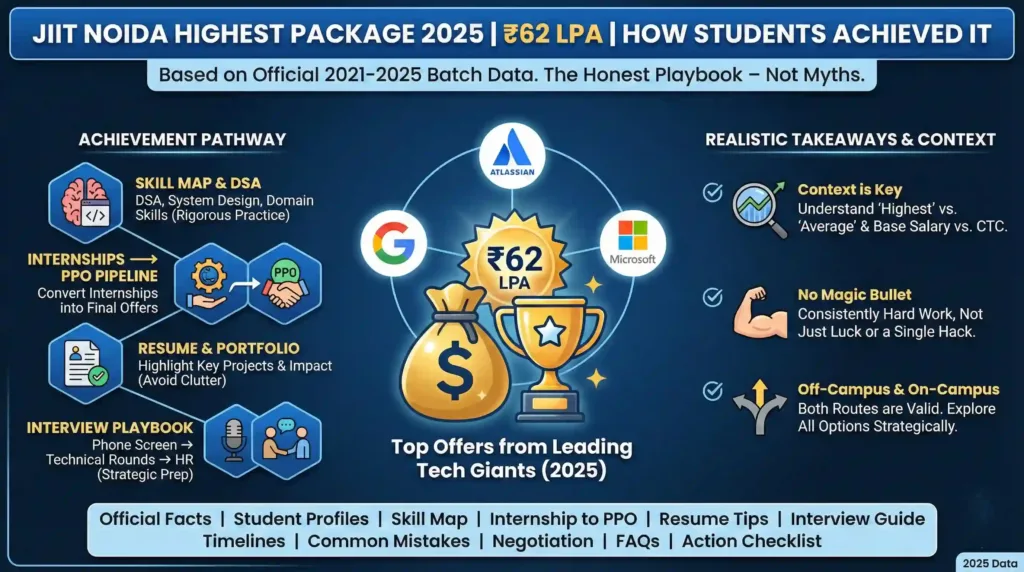
Table of contents
- Official highest-package facts (2025 & historical quick view)
- What “highest package” really means — context & common misreads
- Profiles of students who got top offers (what they did differently)
- Skill map: exactly what recruiters test (DSA, system design, domain skills)
- Internships → PPO pipeline: how to convert internships into final offers
- Resume and portfolio: what to show & what to avoid
- Interview playbook (phone screen → technical rounds → HR)
- Off-campus vs on-campus routes to top packages
- Timelines & semester-wise plan (year-by-year to achieve a top offer)
- Common mistakes & how to fix them (case studies)
- Salary negotiation tips for students who reach shortlists
- FAQs (real, short answers)
- Action checklist & realistic verdict
Please also read these post to clear or doubts –
JIIT Noida CSE Average Package 2025 – Real Placement Data, Trends & Reality Check
JIIT Noida Placements 2025 – Average Package, Highest Package & Branch-wise Data
1) Official highest-package facts (2025 & historical quick view)
Confirmed top offers (selected, official):
- 2021–2025: ₹62.00 LPA — Atlassian (1 offer)
- 2021–2025 — other top: ₹55.38 LPA (Microsoft India), ₹52.75 LPA (Google India — multiple offers)
- Historical comparators:
- 2020–2024: ₹60.71 LPA (LinkedIn)
- 2019–2023: ₹82.89 LPA (Atlassian)
- 2018–2022: ₹1.15 Cr (Amazon EMEA)
What the official data shows: top packages are usually product-company or international roles and come from a very small fraction of the batch. But they repeat over years — i.e., JIIT produces top profiles repeatedly.
2) What “highest package” really means — context & common misreads
Many parents/students see the headline number and assume it’s commonplace. It’s not.
- Highest = headline metric, not representative.
- These offers often arrive to students who have: very high algorithmic skills, strong internship/OSS/competitive programming credentials and one or two standout projects.
- Often the highest packages are off-campus or international and represent offers converted from specialized hiring channels.
Key takeaway: treat highest package as an existence proof (it’s possible), not as the typical outcome. For real decisions, median and distribution matter far more.
3) Profiles of students who got top offers — what they actually did
Below are the distilled, repeatable behaviours that top-offer students followed. These are not “talent” hacks — they are habits.
Profile A – The Competitive Coder (Product role)
- Background: strong CP track record (Codeforces/GFG/LeetCode), frequent contest top-rankings.
- Internships: 2 internships at startups or product teams; at least one full-stack project.
- Interview prep: rigorous DSA practice (timed mocks), system design basics.
- Outcome: shortlisted for Atlassian/Google with coding + design rounds; one converted on-campus offer.
Profile B – The Product-intern convert (PPO route)
- Background: mid-high academic record, 1 high-impact internship at a notable company (PPO possible).
- Internship result: delivered measurable feature (metrics improved), manager recommended for placement.
- Outcome: PPO → full offer at Microsoft/Google.
Profile C – The Domain Specialist (Fintech / Data)
- Background: domain projects (ML/DS/fintech), Kaggle or research internship.
- Interview prep: project discussions, ML/DS case studies, data handling best practices.
- Outcome: high offers from niche teams (e.g., finance tech, analytics) or larger product teams valuing domain expertise.
Common threads across all profiles:
- Early start (from year 2) on coding or domain projects.
- Multiple mock interviews and real company interaction (internships).
- Clean GitHub + live project evidence.
4) Skill map: what recruiters test (exact list)
Recruiters for product roles at top companies typically filter on these layers (you must score on both):
- Data Structures & Algorithms (DSA)
- Arrays, strings, trees, graphs, dynamic programming, greedy, hashing, two-pointer, sliding window.
- Complexity analysis + space/time tradeoffs.
- System Design (basic to intermediate for entry level)
- Designing scalable services, REST APIs, data models, CAP theorem basics, caching and load distribution.
- Large companies expect at least basic distributed systems sense.
- Coding fluency & speed
- Clear variable naming, simple readable solutions, edge cases, and optimization.
- Project competence
- Depth on one or two projects — load, architecture, challenges, your role, metrics.
- Behavioural & problem solving
- STAR answers (Situation-Task-Action-Result), teamwork examples, learning curve, impact orientation.
- Domain skills (if applicable)
- ML pipelines, data pipelines, low-level embedded knowledge for hardware roles, etc.
How to split weekly practice: 60% DSA, 20% projects/internship work, 10% system design, 10% behavioural.
5) Internships → PPO pipeline: step-by-step
Internships are the single most repeatable pathway to top offers if you convert to PPO.
How to secure meaningful internships:
- Build a clear GitHub showcasing at least 1 end-to-end project.
- Apply early (Dec–April for summer), target startups & product companies.
- Use college T&P contacts + LinkedIn outreach.
How to convert to PPO:
- Deliver measurable value (feature shipped, performance improvement, adoption metrics).
- Document the work with tests and PRs.
- Keep manager updated and request feedback; polite conversation about PPO potential in final weeks helps.
Risk mitigation: if internship fails, immediately focus on more interviews; internships are a lever, not the only route.
6) Resume and portfolio: what to show & what to avoid
Must-haves:
- Contact, LinkedIn, GitHub, 1–2 project highlights (bullet points with metrics), internship details with tech stack, education with CGPA (if >7.0).
Portfolio tips:
- Live demo links (Heroku/GCP/Vercel) help.
- Readme should explain challenge → approach → result → your role.
- For ML: include notebooks + data pipeline description and evaluation metrics.
What to avoid:
- Vague statements like “worked on machine learning” without metrics.
- Listing too many tiny projects; prefer 2–3 deep ones.
7) Interview playbook (phone screen → technical rounds → HR)
Phone screen (40–60 min):
- Usually 1–2 coding problems.
- Communication: explain approach before coding.
Onsite / Virtual technical rounds (2–4 rounds):
- Round 1: DSA medium-hard.
- Round 2: System design or coding combined.
- Round 3: Behavioural + domain/project deep dive.
HR / final round:
- Salary discussion, intent, joining timelines.
Common preparation routine for 6–8 weeks:
- 6 days/week DSA practice (LeetCode medium → hard once comfortable)
- 2 mock interviews/week (peer or platform)
- 1 system design walk-through/week
- 1 project note revision per week
8) Off-campus vs on-campus routes to top packages
On-campus: direct applications during placement season; greatest success for students who secured internships / projects and were top in coding. College referrals, T&P coordination, and alumni help amplify reach.
Off-campus: for students who slip the campus window — competing on platforms (LinkedIn, HackerRank/Tech screens) and applying through company portals. This route sometimes leads to international offers and higher packages but needs persistent outreach and interview readiness.
Strategy: combine both — actively apply on campus and simultaneously keep off-campus pipeline warm.
Please also read these post to clear or doubts –
JIIT Noida CSE Average Package 2025 – Real Placement Data, Trends & Reality Check
JIIT Noida Placements 2025 – Average Package, Highest Package & Branch-wise Data
9) Semester-wise roadmap (exact actions by year)
Year 1 (Foundation):
- Learn programming basics (Python/Java/C++)
- Build 1 small project (portfolio start)
- Join coding club
Year 2 (Skill & Projects):
- Start DSA practice (easy → medium)
- Complete 1 open source contribution or team project
- Apply for winter/summer internships
Year 3 (Internship consolidation):
- Convert internship experience to strong project case studies
- Ramp DSA to medium-hard problems
- Start mock interviews
Year 4 (Placement push):
- Interview simulations, system design basics, interview role plays
- Finalize resume & portfolio; get referrals
- Negotiate salary, evaluate offers
10) Common mistakes & how to fix them
Mistake: waiting until final year to start preparation
Fix: start DSA & projects from year 2; treat placement like a product launch with milestones.
Mistake: shallow project descriptions
Fix: quantify — “reduced API latency by 30%” or “improved throughput by X”.
Mistake: neglecting communication & coding readability
Fix: practice whiteboard / pair programming; submit PRs with clear messages.
11) Salary negotiation tips for students who reach shortlists
- Know market ranges (use your own placement stats + industry reports).
- If offered, ask for the full compensation breakup (CTC components).
- Don’t accept first number impulsively; politely ask for 48 hours and evaluate (be mindful of campus windows).
- Use internship/other offers as leverage if real.
12) FAQs
Q1. Is ₹62 LPA typical at JIIT Noida?
No — ₹62 LPA is an exceptional top offer, not typical for most students.
Q2. Can an average student get such packages?
Unlikely without substantial skill development and internships. It is possible but rare.
Q3. Do coding contests matter?
Yes. Competitive programming is a visible signal for product-role hiring.
Q4. How many internships should I do?
Quality > quantity. 1–2 meaningful internships are enough if they show impact.
Q5. Is system design required for freshers?
Basic system design understanding helps for product roles in later rounds.
13) Action checklist — a practical 6-month plan to become shortlist-ready
- Week 1–4: LeetCode easy → medium (solve 60 problems), build README for projects
- Month 2–4: Contribute to one team project + write case study, apply to 10 internships
- Month 5–6: Mock interviews (2/week), system design crash course, update resume and LinkedIn
- Final month: Targeted company practice, negotiation prep, portfolio polish
| Join our whatsapp Channel | Join whatsapp Channel |
| Follow Our Facebook Page | Fb page |
| Our Youtube channel | Youtube channel |
| Our Telegram Channel | Telegram Channel |
| Our Instagram page | Instagram page |
| Follow Our X Page | Join Our X Page |
| Our Official Website Find more jobs | Job Shikhar |
| Our Age Calculation Tools | Click here for Job Shikhar Age Calculation Tools |
| Our Salary Calculations Tools | Click here for Job Shikhar Salary Calculation Tools |
| Our Photo Resizer Tools | Click here for Job Shikhar Age Photo Resizer Tools |
| Our AI Tools Website | Agentive Tech |
Realistic verdict (honest)
Top packages at JIIT Noida are repeatable for students who start early, focus on execution (projects + internships), and practice DSA systematically. This is not luck — it’s consistent habits. If you follow the roadmap above, your probability of a high placement increases substantially.